About
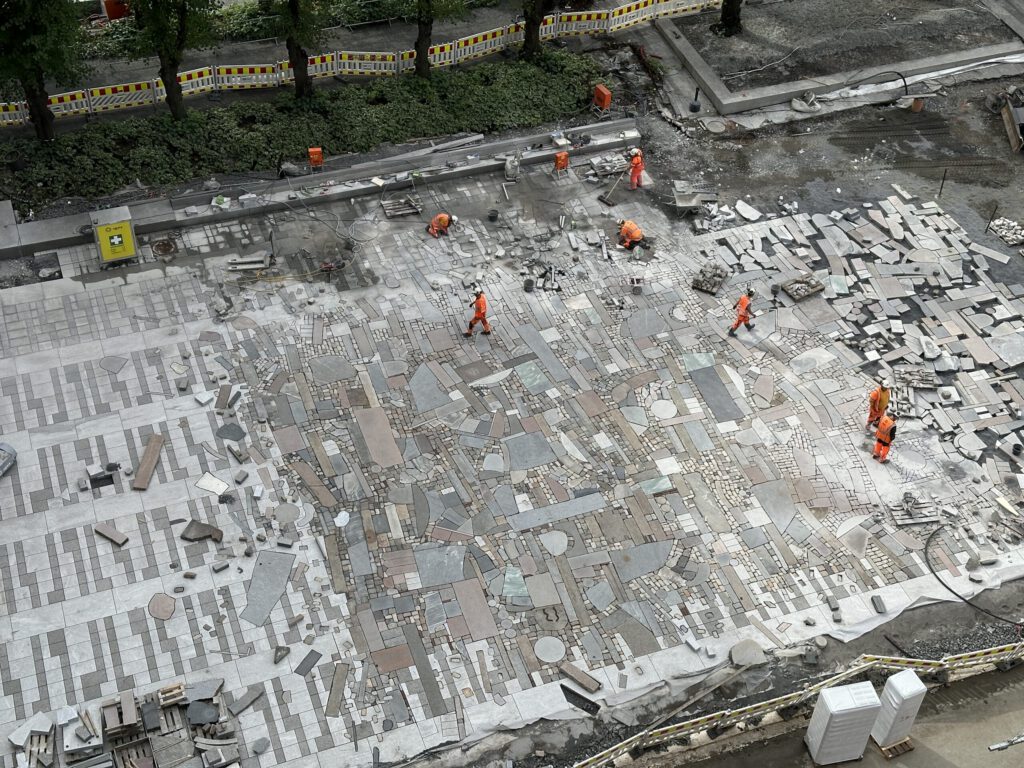
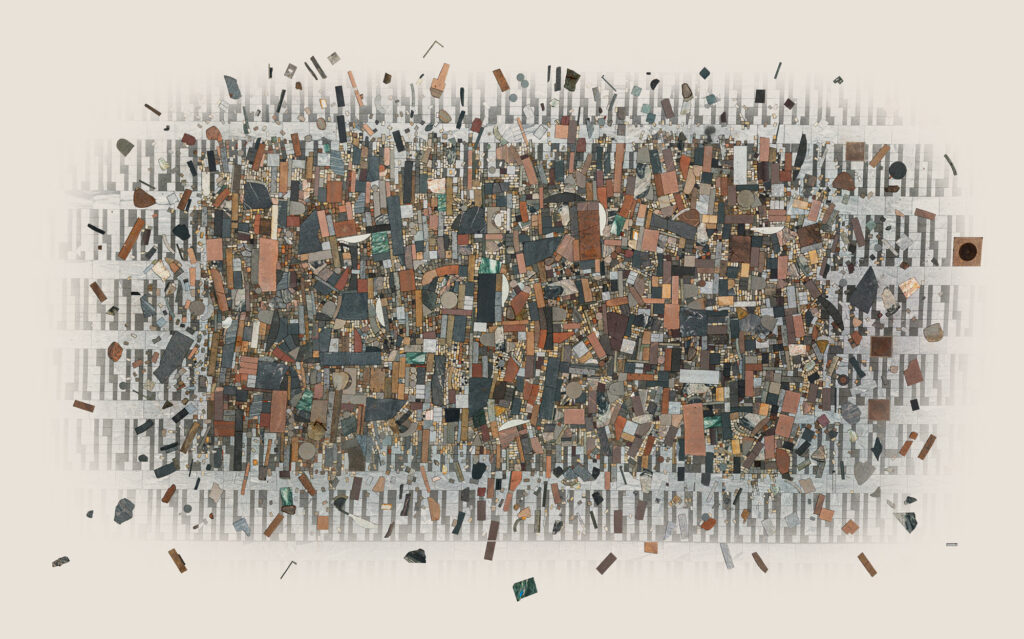
Sebastia is an 800m2 public floor and art work by Jumana Manna in the New Government Quarter, Oslo. Commissioned by KORO – Public Art Norway, the floor is part of the renovation and expansion of the Quarter initiated in the aftermath of the July 22nd, 2011 terror attack, in which a far-right nationalist and Islamophobe detonated a bomb in the heart of the government district before committing a massacre at a Labour Party Youth Camp on the nearby island of Utøya.
Sebastia is composed from ruins, leftovers, and removals donated from excesses of public infrastructure and other sources located in kommuner (“municipalities”) across Norway (over one-hundred sources in all). These include demolitions, renovations, past and present roadworks, prisons, schools, tax offices, factories, dams, bridges, walls, saunas, royal plinths, roundabouts, and more. In the context of the state’s original premise that the floor should be made in Norwegian stone, there were two guiding principles for the research and gathering of materials: a refusal of extraction, so that no new stone would be quarried for this project; and that any stone already in the country, even if it originally came from elsewhere, would be considered Norwegian stone. The act of repurposing these materials asserts an ecology and politics that resists disposability and acknowledges that we share our destiny with the lands that nourish us.
Named after a Palestinian village and important archaeological site, the choice of the title Sebastia expands the work’s engagement with non-contemporaneous architectural encounters, fragmentations and sedimented traditions, while also reversing the pervasive presence of “Oslo” in Palestine by bringing a representation of Palestine into the Norwegian capital. Sebastia’s breakages and stones carry within them symbolic histories of popular struggle while also mediating other mechanisms and histories of infrastructural ruination, extraction, and preservation from Norway, and elsewhere.
We were many hands in the making of Sebastia. From the generous donors, whose culturally rich histories embedded in their donations are gathered in this website, to the team who assembled the floor:
Team
Jumana Manna is a multidisciplinary artist and filmmaker based in Jerusalem and Berlin. After doing her BFA at the Oslo National Academy of the Arts (KHiO), she has had a practice in and out of Norway for twenty years. Manna’s research-driven practice traverses moving image and abstract sculptural assemblages to explore how performing bodies, material fragments, and landscapes both desire and narrate pasts, presents, and futures that remain excessive to the violence imposed upon them. Her work has been shown at numerous film festivals and exhibitions around the world.
Drew Snyder is senior curator at KORO. As part of the overall development of the public art programs for the new Government Quarter, Snyder had the primary curatorial responsibility for Sebastia. He also contributes to the institution’s curatorial and educational initiatives across Norway and Sápmi. Outside of KORO he works regularly as a writer, educator, researcher, and organizer. Drew lives in Oslo.
Eystein Talleraas is an architect, artist, and former urban planner who has been an integral part to the making of Sebastia, contributing with architectural and landscape planning, material collection and dialog with donors, as well as working closely with Manna on the composition of the work. He co-runs the art/architecture studio Vuogas with Joar Nango.
Johansen Monumenthuggeri is a stone artisan workshop in Skjeberg that did most of the slicing of the stone donations into thick slabs, necessary for maintaining a unified height for the floor. Vigdis Johansen led the effort and coordination.
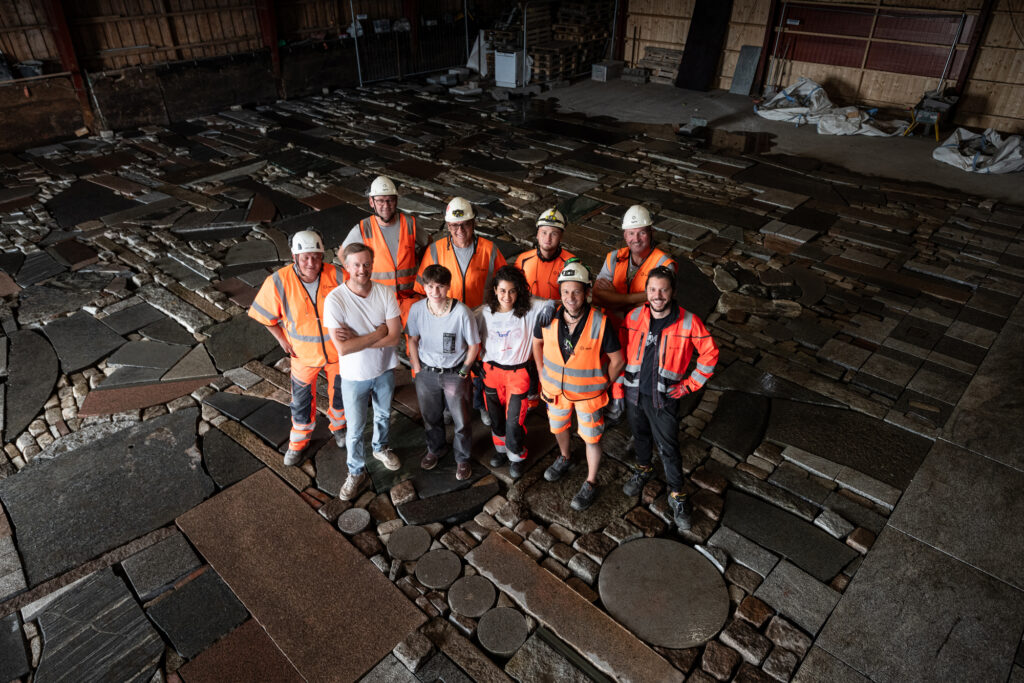
Back row left to right: Kazimierz Smoter, Robert Adrych, Stanislaw Jassica, Hubert Kukla, Slawomir Kita. Front row L to R: Eystein Talleraas, Liv Brissach, Jumana Manna, Rafal Wadas, Drew Snyder.
Agaia was the contracting film responsible for the construction of Sebastia, with Fridtjof Myhrene, Klaus Kristiansen and Rafal Wadas as the project managers. While the the stonemasonry team shifted over the two-and-a-half-year process, Slawomir Kita, Stanislaw Jassica, Kazimierz Smoter, and Maciej Smoter were there almost throughout, driving the machines, diggers, and operating the suction equipment for heavy lifting, as well as carrying out angle-cutting and chiseling work. Robert Adrych, an artist and stone mason was with us in the first year, and contributed the small owl found in the composition.
As the main contractor overseeing the construction of the Government Quarter, Statsbygg, the Norwegian Directorate of Public Construction and Property, and in particular Rannveig Nyegaard Hoffmann, Olav Hovland, Stefan Soos, and Simon Kristoffer Enger Amdal, contributed in meaningful ways to the planning and execution of Sebastia.
Robert Johansson is an artist and project leader in KORO. He helped keep track of the stone’s origins, while also contributing to coordinating transport and dialog with donors. He took over this responsibility from Liv Brissach, who helped set up the system in 2023 before moving to work as Curator at Nordnorsk Kunstmuseum / Davvi Norgga Dáiddamusea.
Colophon
| Artist | Jumana Manna ↗︎ |
| Co-researcher | Eystein Talleraas |
| Curator | Drew Snyder |
| Curatorial team from KORO | Helga Marie Nordby (2025-) Ana María Bresciani (2022-2025) Nora Ceciliedatter Nerdrum (2021-2025) Elisabeth Byre (2021-2022) |
| Producer | Robert Johannson Liv Brissach |
| Project manager | Elise Cosme da Silva Hoedemakers |
| Digital Sketches | Caio Amando Soares Fly Collective AS |
| Mediation & communication | Ida Møller Engebretsen, Ann-Lisbeth Hemmingsen |
| Conservation & Management | Fredrik Qvale |
| Website Design & Development | Samuel Salminen ↗︎ with support from Progressus.io ↗︎ |
| Typefaces | Arketa by Outline Online ↗︎ Install by Arthur Calame ↗︎ |
Sebastia is commissioned by KORO – Public Art Norway – and is part of the newly established government ministries art collection.